

In the bustling streets of ancient Jerusalem, a miraculous event unfolded that would change the course of history. A man, known to all as lame from birth, suddenly rose and walked. This wasn’t just any healing; it was a divine intervention that would spark a powerful message about God’s work in the world.
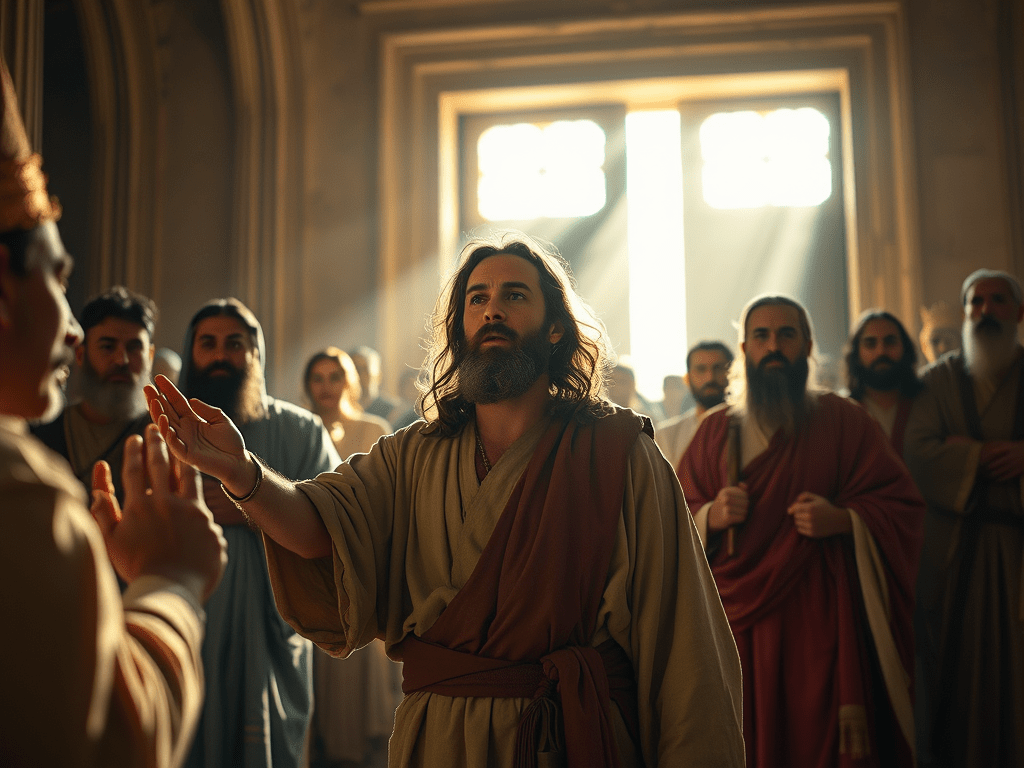
As crowds gathered in Solomon’s Portico, a beautiful colonnade within the temple complex, the air buzzed with excitement and confusion. People ran to see this man they had known for years, now walking and leaping with joy. But amidst the commotion, a profound truth was about to be revealed.
The apostles Peter and John, through whom this miracle had occurred, found themselves at the center of attention. It would have been easy to bask in the glory, to accept the praise and wonder of the crowd. Yet, in a powerful demonstration of humility and purpose, Peter redirected the focus to where it truly belonged – on God.
“Men of Israel,” Peter called out, “why do you wonder at this, or why do you stare at us, as though by our own power or piety we have made him walk?” In this moment, Peter exemplified a crucial lesson for all believers: God works primarily in and through His people, but the glory always belongs to Him alone.
How often do we, in our daily lives, take credit for the blessings and talents God has bestowed upon us? How frequently do we miss opportunities to point others to God because we’re too busy accepting accolades for ourselves? Peter’s response challenges us to constantly redirect praise to its rightful recipient – our Creator and Sustainer.
But Peter’s message didn’t stop there. In a startling turn, he confronted the crowd with a hard truth: “You denied the Holy and Righteous One, and asked for a murderer to be granted to you, and you killed the Author of life, whom God raised from the dead.” These words, sharp as a double-edged sword, cut to the heart of Israel’s rejection of Jesus Christ.
It’s easy to distance ourselves from this accusation, to point fingers at those who lived two thousand years ago. Yet, if we’re honest, we must recognize our own guilt. Every time we choose something other than God, every moment we place our desires above His will, we participate in that same rejection. We, too, stand accused.
However, the beauty of God’s redemptive plan shines brightest against the backdrop of our failure. Despite humanity’s rejection, God continues to work. His purposes are not thwarted by our shortcomings or even our outright rebellion. This is the astounding nature of divine grace – that the very ones who rejected and killed the Messiah are offered life through His name.
Peter declared, “And his name—by faith in his name—has made this man strong whom you see and know, and the faith that is through Jesus has given the man this perfect health in the presence of you all.” Here we see the transformative power of faith in Jesus Christ. It’s not just about physical healing, though that can certainly occur. More profoundly, it’s about the spiritual healing and new life offered to all who believe.
This miracle served as a living testimony to the resurrection power of Jesus. The same crowd that witnessed Christ’s crucifixion now stood as witnesses to His ongoing work through the apostles. It was an undeniable sign that the story didn’t end at the cross – Jesus was alive and active in the world.
As we reflect on this powerful moment in early church history, we’re called to examine our own lives. Are we living as witnesses to the transformative power of Christ? Do we recognize the daily miracles that occur around us, both big and small? And when we see God at work, do we seize the opportunity to redirect glory to Him and share the hope of the gospel with others?
The message rings clear across the centuries: God is at work in this world, and He chooses to work in and through His people. This isn’t because He needs us, but because in His infinite love and wisdom, He invites us to be part of His redemptive plan. What an incredible privilege and responsibility!
Yet, this calling comes with a challenge. Like Peter and John, we must be willing to step out in faith, to speak truth even when it’s uncomfortable, and to always point others to Jesus. We must be ready to offer hope and life to a world that often seems bent on destruction – just as Jesus offered life even to those who crucified Him.
Remember, the same power that raised Christ from the dead and healed the lame man in Jerusalem is available to believers today. The Holy Spirit empowers us to live lives that reflect God’s love and truth to a watching world. We may not perform miraculous healings, but we can certainly be instruments of God’s healing love in countless other ways.
As we go about our daily lives – in our workplaces, our neighborhoods, our families – let’s be acutely aware of the opportunities God places before us. Let’s not miss those divine appointments because we’re too focused on ourselves or too afraid to act. Instead, let’s step out in faith, trusting that God will use us in ways we may never have imagined.
In times of doubt or difficulty, we can anchor ourselves in the faithfulness of God demonstrated throughout history and in our own lives. Just as Peter reminded the crowd of God’s covenant faithfulness to their ancestors, we too can look back and see God’s hand at work. These memories become powerful testimonies that strengthen our faith and embolden our witness.
Today, let us embrace the incredible truth that the God of the universe invites us to be part of His work in the world. Despite our failures and weaknesses, He chooses to use us. May we respond with humility, gratitude, and a renewed commitment to live as faithful witnesses to the transformative power of Jesus Christ.
In a world that often seems chaotic and hopeless, we carry a message of ultimate hope and purpose. Let us go forth, empowered by the Holy Spirit, to make known the love and life found in Jesus – for His glory and the redemption of many.

 Diary of a Sinner
Leave a comment